
History for
Abalos, Brian
- Brown Balls (fu-Gen, 2008)
Under the guise of an Import Car/Cellular Phone/Karaoke Conference, three young Asian men dressed as Bruce Lee, Charlie Chan and Fu Manchu take the audience hostage and force them to listen to their grievances that result from their struggle to justify and redefine their maleness. Brown Balls is an unapologetic, honest, touching and often hilarious exploration of Asian masculinity in a Western context.
Abuba, Ernest
Ernest Abuba is a recipient of an Obie, Rockefeller Playwright Resident Fellowship, (CAPS) Creative Artists Playwright Fellowship, Five NYSCA Fellowships for Playwright and Directing. He is the voice of the Dalai Lama on the Audio Book Art of Happiness, and faculty member of Sarah Lawrence College.
- Cambodia Agonistes (Pan Asian, 198?)
Cambodia Agonistes uses dance, music and speech to tell the story of a traditional Cambodian dancer who suffers through the atrocities of the Cambodian Dictator and is eventually found wondering the streets of NYC, blinded by the memories of what she has seen. - Kwatz! The Sound of a Hammer Hitting the Head (Pan Asian, 2004)
Kwatz! is the exclamatory cry which in Buddhist tradition means an "awakening." Dorje, a Tibetan immigrant, is randomly attacked with a hammer in New York City. In a comatose state, he journeys through his past and present existences where personal dilemmas and certain truths unfolds.
Afzal-Khan, Fawzia
- Jihad Against Violence: Oh ISIS Up Yours (Silk Road, 2017)
A Muslim feminist response to the hijacking of Islam by patriarchal extremists. Afzal-Khan's unfiltered, stream of consciousness reflections provide a potent indictment of the surreal and sardonic world we now inhabit, and a welcome reminder that sisterhood is powerful.
Agustin, Sandra
- Export Quality (Theater Mu, 2000)
Sandra J. Agustin's play proposes to explore Manila's sweatshops, using the phrase export quality to describe not simply the low-priced fabrics produced in Filipino factories, but also the dispossessed people of the Philippines, who export themselves as indentured domestic workers throughout the world.
Ahmed, Sharbari
- Raisins Not Virgins ()
This is a story of a Bangladeshi-American woman who decides to embark on her own version of Jihad, which essentially entails a great deal of drinking and a dubious art project. She initially embarks on this journey out of anger at the Islamic faith, which she feels no place for her, and at her inability to be both American and Muslim. Eventually, the "jihad" leads her to reclaim Islam and allows her to fashion an American identity.
Alcantara, Grace
- Hospital, Airports, And Cemeteries (East West, 2007)
There are three places that you should be for someone you love. A Hospital. Airport. And Cemetery. We all need a little help in transition between eternities.
Alexander, Matthew
- Where is the Love? (East West, 2010)
A Latina Lysistrata in South-Central to a hip-hop soundtrack.
Ali, Wajahat
- The Domestic Crusaders (Rasik Arts, 2011)
A two-act comedy about three generations of a Muslim family living in America. The Domestic Crusaders has been called “an introduction to a new American Muslim cool -- sharp and ironic, funny and deep, running intellectual circles around the idiotic platitudes of bigotry."
Allen, Judith
- My First Husband Married My Second Husband's First Wife (East West, 2010)
When a friendship between two young Army couples, stationed in Germany during the Cold War, turns into wife swapping, their lives fall apart.
Almario, Andrea
- Vacation Sensation (Bindlestiff, 2006)
Almiron, Jennifer
- Lito Loves Buck (East West, 2008)
The sun sets, night presses in-and two boys miss the bus home from Model U.N. In the "crackle-pop" of a night in the wilderness, the boys rise to the challenge of darkness. And war games, gunshots, and strange preteen urges go bump in the night. - Meadowmount (East West, 2009)
What about war? War, two guys and a gun around World War II. An unlikely story about two people falling in love.
Alumit, Noel
- The Rice Room: Scenes from a Bar (Highways, 1999)
The Rice Room: Scenes from a Bar is a skillful and affecting portrait of the gay Asian men who frequent a West Hollywood hangout. Written and performed by Noel Alumit, the piece zooms around the room to present such deft close-ups as an unprepossessing go-go dancer who turns out to be, literally, a rocket scientist, a nerdy queen desperately looking for the man of his dreams, and a Filipino immigrant whose vision of heaven is landing a role in Miss Saigon.
Alvarez, Boni
- Bloodletting (2016)
On a journey to the Philippines to spread her father's ashes, a woman discovers her supernatural powers. Will she embrace her inner good or evil? - America Adjacent (2019, Skylight Theatre)
THE STORY: In pursuit of the American Dream, six pregnant Filipina women risk everything. Confined to a one-bedroom, one-bath unit in Hollywood the women do their best to overcome fears of jail and deportation so that their children can have a better life. Playwright Boni B. Alvarez examines the promise of U.S. Citizenship and ask, "How far would you go to give your child a future?"
Alvarez, Nino
- Untitled (AATC, 2001)
Twelve minute play
Amano, Karen
- Under Western Eyes (Thick Description, 1999)
An adaption of Joseph Conrad's novel Under Western Eyes. A racist political opponent of the Asian American community is assassinated by a terrorist's bomb, and progressive activists applaud the act. Asian American Philosophy graduate student Razuo turns in the assassin (an Asian American activist and fellow student) to the police leading to the assassin's death. Razuo is mistakenly honored by the radical activist community as a collaborator. He must decide whether to assume the false role of collaborator or to face the social and personal consequences of his betrayal.
Anderson, Eric
- Another Heaven (Kumu Kahua Theater, 2006)
Based on a true story, Eric Anderson’s Another Heaven tells a tale of racial conflict, ambition, and greed in late nineteenth-century Hawai`i. Katsu Goto, owner of a general store, tries to help the Japanese plantation workers stand up for their rights against their foreman and the plantation owner. Violence ensues, and an investigator from Honolulu comes looking for evidence that others would rather keep buried. This historical drama won the Kumu Kahua Playwriting Competition’s Hawai‘i Prize in 2001. Another Heaven opens in May 2006. - The Wildbirds (Kumu Kahua, 2017)
Amos and Juliette Cooke had the best intentions. In 1839 Honolulu, the couple was deeply honored to be chosen to personally oversee the education of the children of the kings and queens of Hawai'i. But how does one enforce rigorous discipline on a sacred ali'i child? When is education a form of imperialism? Inspired by historical events, Wild Birds tells the story of intense cultural clashes, the effects of western education on the indigenous monarchy, and the ultimate disillusionment of a teacher.
Anosa, Rima
- Myopia (East West, 2008)
"Love may be blind, but it sure isn't color blind."
Aoki, Brenda Wong
BIO: From the New Victory Theatre on Broadway in New York City, to the Graz Erzahlt in Austria, to Sapporo, Japan, Brenda Wong Aoki has established a new genre as a contemporary storyteller. A writer, performer, and recording artist, she has received numerous grants, fellowships and commissions for her original work. Of Chinese, Japanese, Spanish and Scots descent, her stories blend myth, streetlore, and real life. These dramatic presentations synthesize Kyogen & Noh (Japanese traditional theater), modern dance, and live jazz. Her debut album with composer/musician Mark Izu, Dreams and Illusions: Tales of the Pacific Rim, won the NAIRD best spoken word album of 1990 (INDIE Award) and was released on Rounder Records. The Queen's Garden CD won a 1999 INDIE Award and was released on the Asian Improv Label.
Aoki was named one of the 500 most influential Asian Americans by Avenue Magazine (1996) and received a 1998 Golden Ring Award from the Asian American Arts Foundation. She received the 1998 Innovative Composition award from ASCAP (The American Society of Composers, Authors and Publishers), the US Pan Asian Chamber of Commerce Excellence 2000 Award (Washington, DC), the 1996 Woman Warrior Award (San Francisco), 1996 National Storytelling Championship, and she was the sole artist selected by the Smithsonian to perform before the 1996 National Asian American Congressional Caucus. Ms. Aoki’s plays have become part of the curriculum on several campuses. She is on the Theater Arts faculty at U.C. Santa Cruz and continues to lecture and teach at colleges across the nation.
- The Queen's Garden (Life on the Water Theatre, 1992)
- Random Acts (1994)
- Mermaid (1997)
- Uncle Gunjiro’s Girlfriend (Yerba Buena Center for the Arts, 1998)
The true story of Aoki’s grand-uncle’s love affair and subsequent marriage to a white woman which sparked the anti-Asian miscegenation laws of the early 1900’s.
- Kamau (Kumu Kahua, 1994)
Kamau, first produced by Kumu Kahua for its 1994 summer tour of the Islands, was described by Honolulu Advertiser theater critic Joseph Rozmiarek as a moving and powerful piece on the nature of personal and cultural compromise. The story centers around Alika, a Hawaiian man who works as a guide for a local tour company to support his adopted family. His employer offers Alika a promotion, at the same time informing him that the company has purchased and plans to build a hotel on the oceanfront land where Alika's family has lived and fished for generations. Weighed down with responsibilities and confused by alcohol, Alika struggles with his conscience as he considers his alternatives. No pat answers or one-dimensional characters are offered in Kamau (which means to persevere) as the playwright explores the complex interrelationships, moral ambiguities, and harsh realities of life in contemporary Hawaii.
Apostol, Troy
- Who the Fil-Am I? (Leeward Community College)
Three Filipino-Hawaiians from Hawai`i, all in their mid-twenties, take a trip to the Philippines. Malcom has been there before, as an Ivy League college student teaching English to high school kids, and he's the only one of the three who speaks Tagalog. Ronald, his cousin, is a surfer without much desire to experience the world outside of Hawai`i until this trip. Tomas, Ronald's best friend, appears at first to be little more than a jive-talking, beer-guzzling party animal. Personalities clash and tempers flare as the priorities of the trip are heatedly debated and all three struggle to come to grips with their ancestry and their multi-ethnic, multi-cultural identities. Their odyssey gives theatergoers a taste of life in the Philippines as the trio travels from Manila and Makati to Baguio and the sacred caves of Sagada, and from a descent into the underworld to a new level of enlightenment and understanding of themselves and one another.
Arakawa, Suzanne
- Protected by Law (EWP, 2004)
The years have slipped quickly past a young Sansei whose College Sweetheart died under suspicious circumstances in the Vietnam War. When her dead boyfriend's uncle dies naming her in his will, it sets off a small chain of events leading her to face up to, once and for all, what really happened to her boyfriend.
Armitage, Kimo
- Olo Ka Lau (Kuma Kahua Theatre, 2001)
The story of two Hawaiian brothers, one with an illness with no known cure. Their dilemma is whether to believe in the old ways -- chants and healing rituals -- or the new methods practiced at high-tech hospitals and through over-the-counter drug prescriptions.
Arreola, Daniel
- Dome Light (SIS Produtions, 2006)
Set against metropolitan living, two friends set out to test their self-worth . . . to each other and themselves. Travis and Veronica are two twenty-some-things dealing with the ups and downs of self-medication and the socio-logical norm per se. There’s never a sober moment in this witty, crass, and hysterical look at what friends do to each other and what they don’t want their friends to know. - Oh Look! A Monkey! (SIS Productions, 2008)
The night is long and full of advice for 3 individuals in this dark humored one-act who lost their friend to addiction.
Asis, Stan
BIO: Seattle area actor and one of the early leaders of what eventually became the Northwest Asian American Theatre.
- Philipine Legends, Folklore and American Impressions, adapted from Carlos Bulosan (NWAAT, 1974)
- Transformation: The Monkey King (NWAAT, 1990)
Baisley, Doris and Narasaki, Ken
- The Mikado Project (Lodestone, 2006)
A struggling Asian American acting troupe tries to create their own deconstructed politicized version of THE MIKADO, while dealing with grant deadlines, interpersonal problems, sexual/political issues and an ex-lead actor-turned-TV star.
Baker, Tammy Haili'opua
- My Boy He Play Ball (Kumu Kahua, 2015)
Family bonds are strained when a local high school football star is forced to make a decision about his mainland school scholarship.
Balas, Carmen
- Conversations with Sasquatch (East West, 2007)
Bob is not your average tourist. When Bigfoot meets the Big City, he turns everyone's expectations on their head. Which raises the question: What is human?
Balcazo, Dan
BIO
- I'm Sorry, But I Don't Speak the Language (1998)
- Sort of Where I'm Coming From (1999)
- Say Something (Peeling, 2003)
Is he really the One? Tackling monogamy, domesticity and love from top to bottom, a gay couple explore the matrix of a long-term relationship-largely through a staged version of themselves
Baldwin, Duane Kim
- Putman Transit (Gorilla Tango, 2008)
When two adopted brothers living very different lives reunite after years of estrangement, what starts out as an awkward meeting soon turns into a life-changing experience for the both of them.
Banka, Sarovar
- The Moral Implications of Time Travel (Lark Theatre, 2002)
An immigrant father and son struggle with their past and their neighbors in this haunting story of cultural dislocation.
Banerjee, Neelanjana
- Cowgirls (East West, 2013)
When the Wild West's Calamity Jane and Radha--the consort of Hindu mythology's blue-skinned God, Krishna--find themselves trapped together, they discover that they have a surprising amount in common.
Barall, Michi
Michi Barall, Fluid Motion's 2009 Start the Story Fellow, is an actor, playwright and academic. As an actor, she has worked predominantly on new plays by American writers --including Philip Kan Gotanda, John Guare, Naomi Iizuka, Han Ong, Jose Rivera, Sung Rno, Paul Rudnick, Charles Mee, Sarah Schulman, Anna Deavere Smith, Diana Son, and Chay Yew. The author of three plays, she has had readings with Ma Yi and 2g. Her adaptation of Euripides' Iphigenia in Tauris, if/then, will be produced by Ma-Yi in their next season. She is a proud member of the Ma-Yi writer's lab. She has been awarded two John Golden Incentive grants administered by Hunter College. She is also a usual suspect at NYTW. A graduate of Stanford University and NYU's Grad Acting, Michi is now in her first year in the doctoral program in theatre at Columbia University. She lives in Brooklyn with her husband.
- iphigenia@tauris (Ma-Yi, 2006)
A contemporary, freewheeling adaptation of Euripides’ play, Iphigenia Among the Taureans with influences from Goethe’s version and the Gluck opera. Like the Greek original,the play is a dance-theatre romance about how individuals (and societies) go on after the wreckage of war, domestic or global, and how they begin to return home. - On the Line (Lark, 2010)
Want to know the true cost of your new sneakers? A play inspired by the lives of women workers in the global factory. - How We Became Nomads (Fluid Motion, 2010)
- Matt Park Is Peer Gynt With The Norwegian Hapa Band (Ma-Yi, 2017)
Peer is a brash young man on a journey to discover his ultimate self in this rock music odyssey about risk, reinvention and going roundabout. Ma-Yi Theater Company's remaking of Ibsen's classic verse drama asks what it means when we sacrifice everything to be most fully ourselves.
Barlizo, Marie-Leofeli R.
- Stroke (fu-Gen, 2008)
Between the hours of dusk and dawn a catastrophic event occurs forcing a family to confront the secrets of the past. Stroke explores the meaning of family, responsibility, forgiveness and how we choose to remember our sins.
Baroma, Rebecca
- The Flower And The Firefly (East West, 2008)
Zenith is orphaned, adopted by her aunt and uncle in the United States and forced to live with her uber-Americanized cousin, Amy. Cousins/sisters revisit each other throughout their lives, as time starts in the future and ends in the past.
Barroga, Jeannie
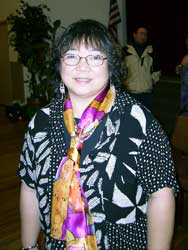 JEANNIE BARROGA, is an Active Member in the Dramatists Guild. She was literary manager 1985-2003 at TheatreWorks. She had founded in 1983 the Palo Alto Playwright Forum. The Off-Off Broadway play Rita's Resources was produced by Pan Asian Repertory. She received the Maverick Award (Los Angeles Women's Festival), was awarded the Tino Award, the Joey Award, and was nominated for the CalArts Herb Alpert Award 2000. She had also won the Bay Area Playwrights Festival 10-Minute Play Contest and had two plays developed with BAPF. Barroga served on panels for Theatre Communications Group, the National Endowment for the Arts, the San Francisco Arts Commission, and at the Santa Clara, Oakland, and Marin Arts Councils. She assisted on TheatreWorks' OO-BLA-DEE and VOIR DIRE, directed the tour of KIN, and KENNY WAS A SHORTSHOP at Brava! for Women in the Arts. Her plays have been published such as: WALLS (Asian American Theater), TALK-STORY (TheatreWorks), and EYE OF THE COCONUT (Northwest Asian American Theater). TALK-STORY has also produced at UC-Davis, Kumu Kahua in Honolulu, with workshops at the Mark Taper Forum, Perseverance Theatre, and Western Stage. Barroga served on panels for Theatre Communications Group, the National Endowment for the Arts, the San Francisco Arts Commission, and at the Santa Clara, Oakland, and Marin Arts Councils.
- When Stars Fall (Foothill Studio, 1986)
- Eye of the Coconut (NWAAT, 1987)
- Walls (AATC, 1989)
Walls is a play about the design and building of the Vietnam Veterans Memorial in Washington, D.C., and the controversy surrounding it and its designer, Maya Lin, a 21-year-old Chinese American student. But the drama is about other walls as well -- the walls that separate us individually and racially, walls of bigotry and fear and misunderstanding. - Kenny Was a Shortstop (Brava Studio Theatre, 1991)
Kenny gives the audience a glimpse into the hearts and minds of the parents who continue to mourn the untimely death of their son, who happened to be in the wrong place at the wrong time. - Talk Story (TheatreWorks, 1992)
Talk-Story focuses on the Filipino immigrant experience. The central character is Dee Abano, a first-generation American daughter in love with old movies, but caught up in an identity crusade. She is also a newspaper copy assistant beginning a series of articles on the Filipino experience, most of which are based on her father's colorful and often-told stories. The situation gives Barroga the opportunity to rapidly bounce between Dee's contemporary experiences and those of her father and uncle in the Philippines and California. Simultaneous histories unfold: the men confronting discrimination with pride and humor, and Dee challenging lingering prejudice and ignorance with fierce determination. What evolves is the clear message that all coping methods come with a price. The older brothers drift into bitterness and denial, while Dee exhausts herself defending against unintended slights. Eventually Dee learns the real truth behind her father's stories and discovers that both of them have used fantasy to escape from a reality that is often imperfect. - Rita's Resources (Pan Asian, 1995)
Review here. - The Game (1998, Theatre of the Yugen)
- A Good Face (1998)
- The Bubblegum Killers (Il Teatro, 1999)
This period musical depicts a dramatic interpretation of an actual event in San Francisco in the 1930s and follows the path of one enterprising Filipino immigrant on his climb as a gang leader who defies the existing labor conditions when his cousin is mistakenly killed. - Gadgets (2000, TnT)
GADGETS is a comic drama that begins with a family reunion of sisters, a black sheep inventor daughter, resentment, past ghost, and an aging mother's mental disapation, and a dead father who finds it hard to leave his family behind. - Banyan (AATC, Bindlestiff, 2005)
The reluctant heroine, Ona, discovers company secrets and takes and adventurous journey revealing them. There is another kind of danger strolling through paradise, however. Escaping one world weighed down in intrigue and shadiness into another with its own danger laced with devouring spirits teaches Ona and her brother, Ian, the perils and necessities of taking stands. Her trek is a thinly disguised homage to Dorothy's accidental travel to the MGM-tinted Oz, with her trio of guards resembling other Oz-like characters. - My Friend Morty (Eureka Theatre/AATC, 2006)
Will Autumn love release 3 friends from their cages? When teen memories confront Mike while visiting Morty – whose
cage is more inescapable: Mike's past or Morty's braces? Almost frozen in time, the childhood home shared by Morty and sister, Nance, seems to encase her as well in another kind of cage. Staging simultaneous scenes between adolescence and adulthood, a poignant tale emerges on friendship, aspirations, and tugging allegiances. - M (Kearney Street Workshop, 2006)
Four people's lives connect the stringlike circle of missed opportunities, unlikely but fated couplings, and unrequited love. "M" is the current darling theory (superseding Einstein's on relativity, which superseded Newton's on gravity) – in short, string theory. "M" is reputed to be theorist Ed Witten's private fun on the letter itself, only upside down, of the first letter of his last name. - Dinuguan (Filipino Community Center, 2007)
An adaption of Blood Wedding. - Aurora (2013)
Grady consumes true crime episodes, exasperating Will; nephew WonderJay is mesmerized by video games; his parents, suburban hunter Hank and wound-up Marcie, smolder in thick air and guilt while June¹s ghost observes them all. This is a setting where psychic ability is a given, simultaneous scenes play out in 2 to 3 locations while a courtroom waiting game plays out. Aurora, Colorado was the July 2012 site of a dozen deaths of which the accused pleads insanity -- 20 miles away for a single murder, loved ones reflect on a similar plea.
Basco, Dante
- The Midnight Makeout Session (EWP, 2009)
3 friends faced with life after their 20's... Looking ahead for what's to come while yearning to recapture the magic moments of their teens in regards to women & love. Slowjams, slowdancing & revisiting your first kiss: "The Midnight Makeout Session."
Batayola, Maria
- Gathering Ground (Asian Theatre at the UW, 1985)
- Love Sutras (with Chris Wong) (NWAAT, 1988)
Bau, Alan
- Red Letters (Vancouver Asian Canadian Theatre, 2007)
Red Letters is about a Chinese immigrant, Liang, who moves to Canada to seek his fortune and leaves his wife, Mei, in China with the hopes of bringing her over once he establishes himself. However due to the Canadian laws at that time, a head tax of $500 was required to bring any Chinese immigrant to Canada in the 1920's. This was a high sum to pay and it took many years for Liang to save the tax money. When he can wait no longer, he borrows the rest from his understanding Laundry Busimess boss, but the Exclusion Act of 1923 made it impossible for him to bring his wife over. In desperation to see Mei again, Liang plans to leave for China; tragically, they are kept apart.
Bayer, Daniel
- The Toad (EWP, 2006)
A short play adapted from the famous tale by Hans Christian Anderson.
Bie, Branson
- Under the Banana Tree (At the UW, 1984)
New "traditional" Asian fairy tales in stage format
Benoza, Noel
- A Package for Mr. Hartella: A Tall Tale in Three Acts (AATC, 1999)
Nino Maguyan is a burned out artist, engrossed with violence and doom. Honoring his sick father's request, Nino, his ex-wife, his sister and her boyfriend, drive his father from San Francisco to Las Vegas to deliver a package to an aging Casino entertainer suspected of mob ties.
Bensinger, Lenore & Johnson, Christopher
- Yeb-Yang-Ah (NWAAT, 1992)
Original commissioned show on adoption of Korean children by white American families.
Berman, Brooke
- Dancing with a Devil (Humana Festival, 1999)
Unspeakable moments, too painful for words, transform a young woman's life through a graceful dance that leads to the point of no return.
Bernardo, Danny
- Mahal (Baliwick Chicago, 2013)
Mahal is a new play about how one Filipino American family redefines itself after loss and reclaims their culture. One of the first plays about a Filipino American family, Mahal centers on the Reyes family dealing with the loss of their matriarch. As new relationships blossom and family bonds are tested, a long forgotten secret from the homeland threatens to tear the family apart. Dealing with themes of cultural identity, assimilation, homophobia, interracial and inter-generational relationships, Mahal examines what it truly means to be an American family. - Better Half (Baliwick Chicago, 2014)
Fraternal twins Thea and Teddy lead separate but identical lives. Whether it's been for the affection of their parents, the best grades, or success as an adult, the two have been in a lifelong competition with each other. When their mother suddenly returns from tragedy in the Philippines, Thea and Teddy are forced to not only reconcile their relationship, but face the reality about the lives they actually lead.
Bhatt, Sujata G.
- Queen of the Remote Control (EWP, 2000)
"Bhatt gives us a look into one week in the lives of an immigrant Indian family and explores the basic question of ethics: what does it mean to live a good life. Although the question is an old one, the play develves into contemporary issues such as happiness and fulfillment in a world dominated by television, biotech research, multibillion dollar corporate deals, and class upward mobility." (Also, AATC) - The Aunties (Artwallah, 2001)
One act play.
Bolia, Steve
- The Imperfect Daughter (Playwrights Initiative 1999)
Three Vietnamese sisters harboring secrets confront their past and their mother, awoman with a few secrets of her own.
Bond, Kathryn S.
- Cane Fire (Kumu Kahua)
A look at Hawaiin plantation workers in the 1930s.
Bressenbruge, Mei Mei
- One Cup, Two Cup (NWAAT, 1979)
Brown, Angie
- Junior's Black Star (EWP, 2006)
After 13 years behind bars, Junior has been released to the loving care of his Aunt Pearl, only to discover that he is imprisoned by his own mind.
Brown, Darren Lee
- Dinner with the Browns (AATC, 2001)
Twelve minute play
Brown, Meghan
- Psyche (East West, 2010)
As Peter's family unravels below him, he finds himself increasingly drawn to the attic, where he is visited by the mythical character Psyche. A story of betrayal, obsession, and the redemptive power of love.
Byun, Harold
- The Butcher's Burden (AATC, 1999)
In Korea, the butchers were untouchables. In America, Park Sun-Woo carries a secret even while he runs a shady detective agency. With man-hater Sophia and coked-up voyeurist Will, he digs up and manufactures the secrets and scandals that create a new butcher class. The two have a common background as a wild-goose chase becomes a "lives-and-deaths" encounter in this karmic comedy.
